





Quick Summary
- Networking accessories help build stable, organized, and secure data connections in homes, offices, shops, warehouses, schools, and commercial buildings.
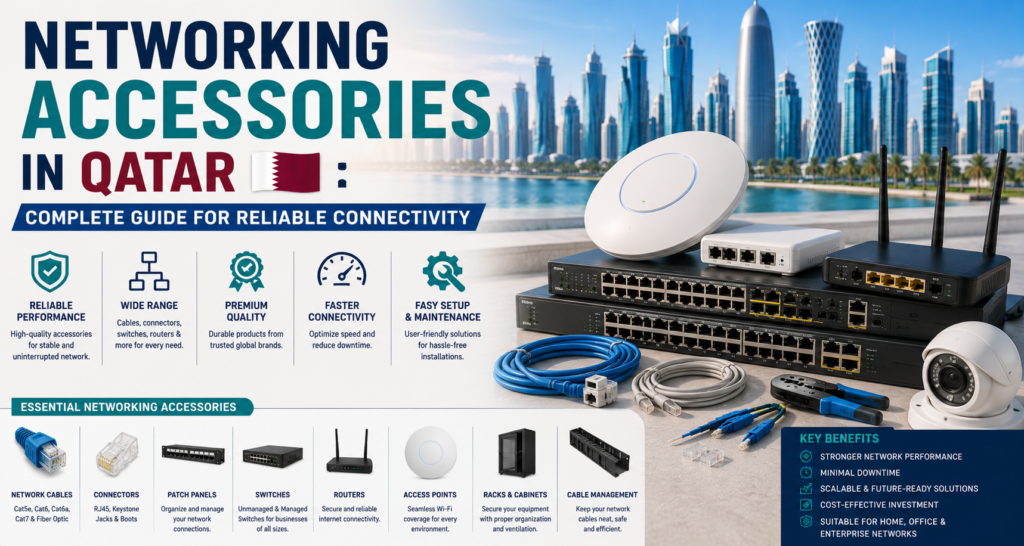
- Common networking accessories include Cat6 cables, patch panels, RJ45 connectors, switches, UPS units, rack shelves, cable managers, trunking, cable ties, and faceplates.
- Choosing the right networking accessories in Qatar improves speed, reduces signal issues, and makes maintenance easier.
- Buyers should check cable category, installation environment, compatibility, durability, rack organization, and future expansion needs.
- Good structured cabling supports business continuity, digital operations, smart systems, CCTV, access control, Wi-Fi, and data networks.
Table of Contents
- What Are Networking Accessories?
- Why Networking Accessories Matter In Qatar
- Common Networking Accessories Used In Qatar
- How Networking Accessories Work Together
- How To Choose Networking Accessories In Qatar
- Key Buying Checklist For IT And Facility Teams
- Where Networking Accessories Are Used
- Mistakes To Avoid When Buying Networking Accessories
- Internal And External Link Suggestions
- Conclusion
- Frequently Asked Questions
Definition of the Topic : What Are Networking Accessories?
Networking accessories are the supporting products used to connect, protect, manage, and organize data networks. They may not always be the main devices, but they are essential for reliable network performance.
A network does not depend only on routers, servers, switches, or internet service. It also depends on cables, connectors, racks, cable management, power backup, patching, labeling, and protection. Poor accessories can create slow connections, weak signals, messy racks, cable damage, and difficult troubleshooting.
For example, a Cat6 cable supports wired network communication. RJ45 connectors terminate Ethernet cables. Patch panels organize network points. Rack shelves hold equipment. UPS units protect equipment during power interruptions. Cable management accessories keep cables arranged and reduce strain. Trunking protects cable routes across walls, floors, and workspaces.
This is why many contractors, IT teams, system integrators, and business owners search for Networking Accessories In Qatar. They want practical products that support clean installation, stable connectivity, and long-term maintenance.
Star Techno Trading provides related categories such as Networking Accessories, Cat6 Cables, Cables, Cable Management Accessories, Trunking, and Electrical Supplies.
1. Why Networking Accessories Matter In Qatar
Qatar’s business and infrastructure environment is becoming more digital. Offices, retail stores, hospitality spaces, schools, warehouses, clinics, government facilities, and residential buildings all depend on strong connectivity. Internet, cloud systems, video calls, CCTV, access control, smart lighting, point-of-sale systems, building automation, and Wi-Fi access points all need reliable cabling and network support.
Qatar’s Digital Agenda 2030 is focused on national digital transformation, including connectivity, digital infrastructure, high-performance computing, and automation. That wider digital direction makes dependable network infrastructure more important for businesses and buildings.
A stable network starts with good accessories. Poor cable quality, loose connectors, unorganized patching, weak rack setup, or lack of power backup can affect performance. Even a small accessory can create a major issue if it is not selected properly.
Good networking accessories help with:
- Faster data transmission.
- Cleaner installation.
- Easier troubleshooting.
- Safer cable routing.
- Better equipment protection.
- Lower signal loss.
- Reduced cable damage.
- Improved future expansion.
- Better rack airflow.
- More professional project handover.
2. Common Networking Accessories Used In Qatar
Networking accessories vary by project size. A small office may need cables, connectors, faceplates, and a small switch. A commercial facility may need racks, patch panels, cable managers, UPS units, cable trays, and organized structured cabling.
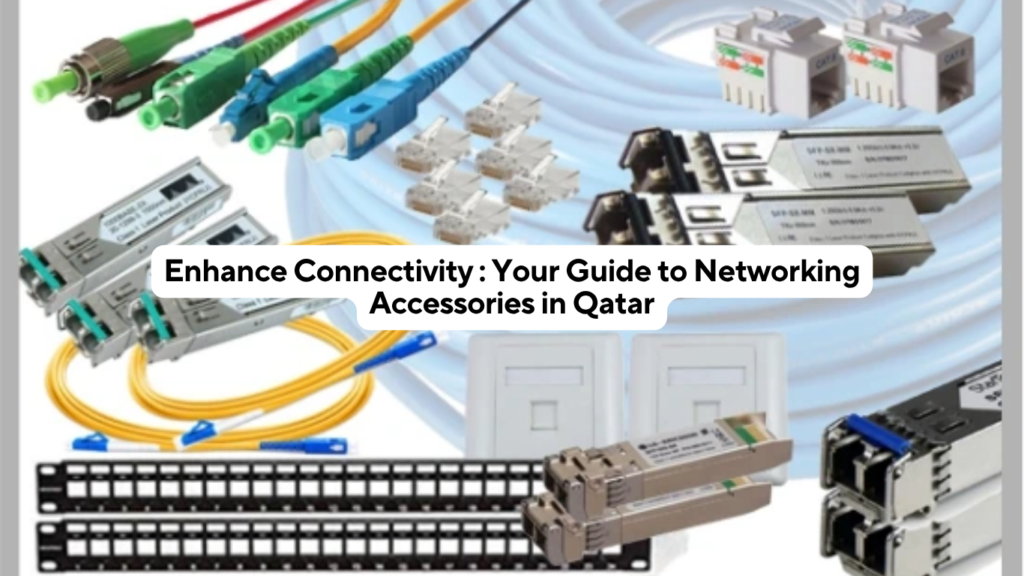
Common networking accessories include:
Cat6 cables and Cat6A cables: These are used for Ethernet connections. They support fast wired networking when installed correctly.
Patch cords: These connect devices, patch panels, switches, routers, and network outlets.
RJ45 connectors and boot covers: These help terminate and protect Ethernet cable ends.
Patch panels: These organize cable runs in a rack. They make moves, additions, and changes easier.
Network switches: Switches connect multiple network devices and allow communication across the network.
PoE switches: These can supply data and power to supported devices, such as IP cameras, access points, and VoIP phones.
UPS units: These provide backup power and protect network devices from short power interruptions.
Rack shelves: These support non-rack-mounted equipment inside network cabinets.
Cable managers: These keep patch cords neat and reduce cable strain.
Trunking and conduits: These protect cables along visible or exposed routes.
Cable ties and Velcro tape: These help organize cables without damaging them.
Faceplates and keystone jacks: These create clean network outlets for offices, meeting rooms, homes, and commercial spaces.
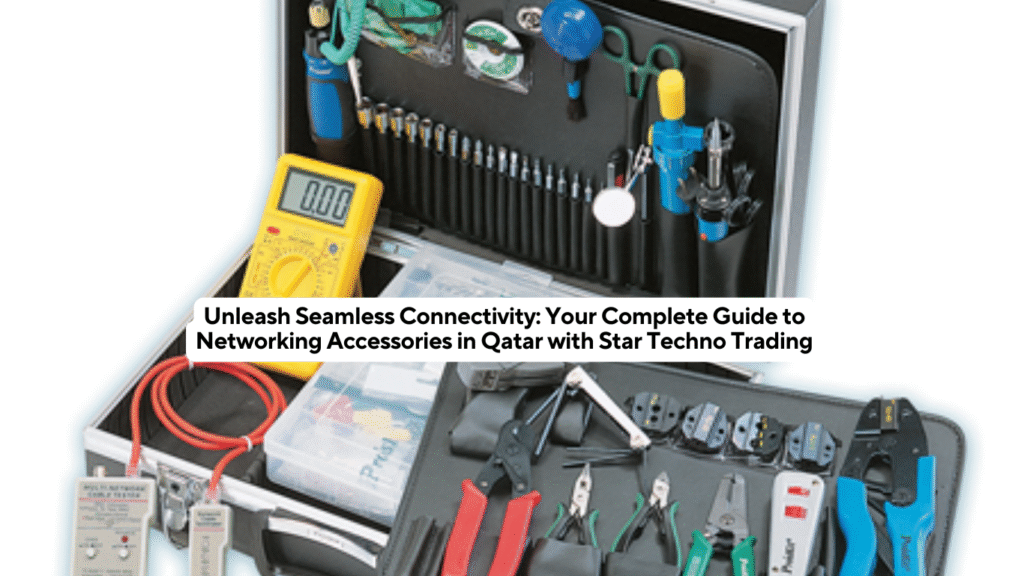
Cable testers: These help confirm continuity and correct wiring after installation.
Star Techno Trading’s Networking Accessories category is the main internal link for this blog. Use Cat6 Cables and Cable Management Accessories as supporting links.
3. How Networking Accessories Work Together
A network is a system. Each accessory has a role.
The process often works like this:
- Network cable is pulled from the rack to the work area.
- The cable is protected through trunking, conduit, or cable management routes.
- The cable is terminated using RJ45 connectors or keystone jacks.
- Work area outlets are installed using faceplates.
- Cable runs are connected to a patch panel.
- Patch cords connect the patch panel to a switch.
- Network switches connect computers, access points, cameras, phones, or other devices.
- UPS units protect critical equipment from power interruptions.
- Rack shelves and cable managers keep the cabinet organized.
- Cable testers confirm that the installation works correctly.
When all these accessories are selected properly, the network becomes easier to manage. When they are selected poorly, the network may work at first but become difficult to maintain.
4. How To Choose Networking Accessories In Qatar
Choosing networking accessories in Qatar requires more than buying any available cable or connector. Buyers should match the product to the system requirement.
Use the following steps.
Step 1: Identify the network purpose.
A simple internet connection, CCTV system, office LAN, data cabinet, Wi-Fi project, smart home, or commercial building network may each need different accessories.
Step 2: Choose the correct cable category.
Cat6 is commonly used for modern wired networks. Cat6A may be considered for higher performance needs or future-ready installations. Check the project requirement before buying.
Step 3: Check cable length and installation route.
Long cable runs, exposed routes, ceiling routes, and rack-to-desk routes need planning. Cable protection may be required.
Step 4: Check shielding needs.
Some environments have electrical noise or heavy equipment nearby. In such areas, shielded cable may be needed.
Step 5: Use proper connectors and termination accessories.
A good cable can perform poorly if it is terminated with low-quality connectors or poor workmanship.
Step 6: Plan the rack properly.
Use patch panels, cable managers, rack shelves, and labeling. A clean rack saves time during troubleshooting.
Step 7: Add power protection.
A UPS helps protect switches, routers, and other network equipment during short power interruptions.
Step 8: Think about future expansion.
Do not design only for today. Add space for more ports, more devices, more cameras, more access points, and more workstations.
Step 9: Buy from a supplier with related categories.
Network projects often need cables, cable ties, trunking, electrical supplies, tools, and installation accessories. Star Techno Trading’s Shop helps buyers browse multiple categories from one place.
5. Key Buying Checklist For IT And Facility Teams
Before buying networking accessories, prepare a clear requirement list. This reduces wrong purchases and delays.
Use this checklist:
- Project type: office, home, retail, warehouse, hotel, school, clinic, or industrial site.
- Required cable type: Cat6, Cat6A, patch cord, HDMI, or other cable.
- Cable length and roll quantity.
- Number of network points.
- Number of switch ports required.
- PoE requirement for cameras, access points, or phones.
- Rack size and cabinet space.
- Need for patch panels or rack shelves.
- Need for trunking or cable protection.
- UPS backup requirement.
- Installation area conditions.
- Testing and labeling requirement.
- Quantity of RJ45 connectors, boot covers, faceplates, or cable ties.
- Delivery location in Qatar.
- Urgency and project deadline.
This checklist helps the buyer communicate clearly with the supplier. It also helps avoid under-ordering or choosing incompatible accessories.
6. Where Networking Accessories Are Used
Networking accessories are used in many types of Qatar projects.
Offices:
Offices need data points, Wi-Fi, printers, meeting room screens, IP phones, and secure internet access.
Retail stores:
Retail networks support point-of-sale systems, CCTV, payment devices, inventory systems, and Wi-Fi.
Hotels and hospitality spaces:
Hotels need reliable networks for guest Wi-Fi, booking systems, access control, CCTV, IPTV, and back-office systems.
Warehouses:
Warehouses use networks for barcode scanners, inventory systems, CCTV, access points, and admin offices.
Schools and training centers:
Education facilities need stable connections for classrooms, labs, admin systems, and online learning.
Homes and villas:
Modern homes need structured cabling for Wi-Fi access points, smart TVs, security cameras, and smart home devices.
Industrial sites:
Industrial networks require durable installation, cable protection, organized cabinets, and dependable power backup.
Qatar’s local internet infrastructure is also developing. The Qatar Internet Exchange states that one of its goals is improving internet connectivity in Qatar and supporting scalable interconnection between networks. This broader connectivity context supports the need for better network infrastructure inside buildings too.
7. Mistakes To Avoid When Buying Networking Accessories
Avoid these common mistakes.
Buying cable without checking the category.
Do not assume all Ethernet cables are the same. Cable category affects performance.
Using poor-quality connectors.
Bad connectors can cause weak connections and signal loss.
Ignoring cable management.
Messy cables make troubleshooting difficult. They also increase the risk of accidental disconnection.
Skipping UPS protection.
Network equipment can shut down during power interruptions. A UPS helps protect key devices.
Not planning enough ports.
A network should allow future devices. Always plan spare capacity.
Running cables without protection.
Cables can be damaged in exposed areas. Use trunking, conduit, or cable management accessories when needed.
Not testing after installation.
Every network point should be tested before handover.
Choosing based only on price.
Low-cost accessories may create maintenance problems later.
Conclusion
Networking accessories in Qatar are essential for stable, clean, and future-ready connectivity. A network is only as strong as its supporting components. Cables, connectors, switches, UPS units, patch panels, rack shelves, trunking, cable ties, and cable managers all play a role in performance and maintenance.
For homes, offices, shops, warehouses, schools, hospitality spaces, and industrial buildings, the right accessories reduce network issues and make future upgrades easier. Buyers should check product category, cable type, compatibility, installation area, power backup, and stock availability before ordering.
Star Techno Trading’s Networking Accessories category is a useful starting point for sourcing network accessories, Cat6 cable, rack items, cable protection, and related electrical products in Qatar.
Frequently Asked Questions
1. What are networking accessories?
Networking accessories are supporting products used to build and manage data networks. They include Ethernet cables, Cat6 cables, RJ45 connectors, patch panels, switches, UPS units, rack shelves, cable managers, trunking, cable ties, and faceplates.
2. Why are networking accessories important?
Networking accessories are important because they affect speed, stability, cable safety, rack organization, and troubleshooting. Poor accessories can cause slow connections, loose terminations, cable damage, and messy installations.
3. What networking accessories are commonly used in Qatar?
Common networking accessories in Qatar include Cat6 cables, patch cords, RJ45 connectors, switches, UPS units, rack shelves, cable management accessories, trunking, cable ties, faceplates, and patch panels.
4. How do I choose networking accessories in Qatar?
Choose networking accessories by checking cable category, project type, installation route, rack requirement, connector quality, UPS backup needs, and future expansion. For larger projects, prepare a clear quantity and specification list before buying.
5. Where can I buy networking accessories in Qatar?
You can explore Star Techno Trading’s Networking Accessories, Cat6 Cables, and Cable Management Accessories pages, or send an enquiry through the Contact Us page.
